
I have had this photograph for about 30 years and know absolutely nothing about it but have found it to be quite intriguing. The skill that has gone into converting an overhead valve engine into a OHC engine would have been something very difficult to achieve on a home workshop Myford ML7.
So why convert what would be considered a ‘grey porridge’ road engine into something more sporty and given that AMCs 500 twin race bike, the Matchless G45, was still just a pushrod driven overhead valve motor that achieved success on the race track, we still come back to the simple question of why, why, why?
Looking into the OHC engine and the advantages that they provided history has proven that success of these types of engines were evident from the very early days of racing. Overhead cam engines have been around since the beginning of motorcycling, perhaps the most well known from the 1920s would be Velocettes KTT and KSS machines, or even the Norton CS1. Into the 1930s would be the AJS R7 and the Norton International. And by the late 1940s the success of the AJS 7R 350cc racer (commonly known as The Boy Racer) would have been top of the wish list of many a budding young racer, and if successful then one could perhaps graduate to a Matchless G50 500cc OHC single or even the Manx Norton. So what is the story on this photograph?
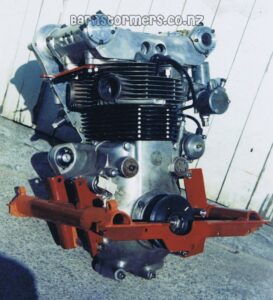
I have been assuming that this engine was for a motorcycle which could be completely wrong.
In the 1950s and 60s motorcycle engines were powering Formula 3 racing cars which could have had anything from a single cylinder JAP, Norton Manx or Inter engines, or even the good old Triumph twin cylinder. The cradle supporting this engine is not really suitable for a motorcycle frame, and the output shaft seems to support a drive coupler. Was this for an electric start unit to be used to fire up the motor, or as a quick coupler to a drive unit for a Formula 3 race car? The overhead cams are most likely chain driven from the right hand side as a tensioner can be seen in the front of the timing cover on the left hand side of the photograph. To assist in the tuning of the engine there was the inclusion of a rev counter drive mounted off the rear camshaft, left hand side. But then again performance would have been limited to the single Monobloc carburettor fitted. So many questions?
So was this a NZ build? Or from the engineering skills of another from overseas.
Sadly I have only this one photograph, and like all of you who are interested in such modified engines we can do nowt but wonder what the plan was, and was it successful?
Ultimately though, what a great piece of engineering and doesn’t it look handsome.
Anybody out there have any ideas of its origin? And does it still exist? Chat to us through our Contacts Page.